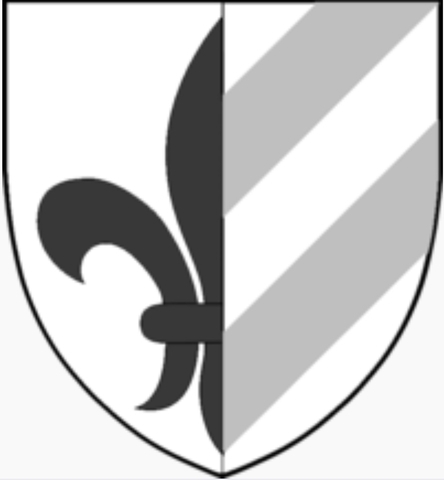
Sköldemärke från riddaren Johan Elofsson, den mest kände i släkten.
Elof, stamfar Elofsönerna ~1200–
Kön: Man
Levnadsbana
| Född | omkring 1200 1 |
| Sonen Johan Elofsson föds (≈20) | omkring 1220 2 |
| Sonen Anders Elofsson (Elofsönerna) föds (≈41) | efter 1240 Östergötland, Sverige3 |
| Sonen Anders Elofsson (Elofsönerna) dör (≈95) | omkring 1295-11-04 Östergötland, Sverige4 |
| Sonen Johan Elofsson dör (≈95) | efter 1295-11-04 5 |
Familj
Personanteckningar
Elof, stamfar Elofssönerna
Elofssönernas ätt
https://sv.wikipedia.org/wiki/Elofss%C3%B6nernas_%C3%A4tt
The House of Elofssons, by Swedish Biographical Lexicon, retrieved 2023-01-28
Volume 13 (1950), page 407.
Biography
Elofssönernas ätt, conventional family name of a medieval High Salvation family from Östergötland. The family's older origins are unknown, and there is also a lack of further information about its progenitor, who must have been called Elof (Elef) because of the sons' patronymics. The family was previously erroneously listed as a branch of the Ángel family; neither did the progenitor's spouse, as stated, belong to the said family. C. Annerstedt and H. Toll have separately assumed that the progenitor Elof was a member of the Folkunga family, but the matter has not been proven and is not probable. The difficulty of clarifying the genealogy is increased by the fact that the arms of the sons of Elofs, if they had something common to the whole family, are not known. Only for Peter Andersson (see below) is a coat of arms indicated, but this is not preserved; the information originates from J. Peringskiöld, but even if it is correct, the seal's coat of arms may have been individual, and in any case no family structure can be built on it. However, when it emerged towards the end of the 13th century, the family belonged to the kingdom's highest aristocracy. Its local origin is evident partly from inheritance documents, partly from two documents in connection with the question of canonization of Elof's daughter Ingrid (see below). So write e.g. Eric of Pomerania in a petition on April 1, 1414 to Pope John XXIII, that Ingrid was from a "noble Gothic family" (ex nobili gothorum prosapia oriunda). The Elofssons' ancestral estates were located in the Aska district in northwestern Östergötland, but the family also owned estates in Ottenby on Öland. Its most notorious members are two of the progenitor Elof's children, namely Ingrid Elofsdotter (see this one), died in 1282, better known as the saint "Ingrid of Skänninge", and the knight and you can in any case not build any family structure on that. However, when it emerged towards the end of the 13th century, the family belonged to the kingdom's highest aristocracy. Its local origin is evident partly from inheritance documents, partly from two documents in connection with the question of canonization of Elof's daughter Ingrid (see below). So write e.g. Eric of Pomerania in a petition on April 1, 1414 to Pope John XXIII, that Ingrid was from a "noble Gothic family" (ex nobili gothorum prosapia oriunda). The Elofssons' ancestral estates were located in the Aska district in northwestern Östergötland, but the family also owned estates in Ottenby on Öland. Its most notorious members are two of the progenitor Elof's children, namely Ingrid Elofsdotter (see this one), died in 1282, better known as the saint "Ingrid of Skänninge", and the knight and you can in any case not build any family structure on that. However, when it emerged towards the end of the 13th century, the family belonged to the kingdom's highest aristocracy. Its local origin is evident partly from inheritance documents, partly from two documents in connection with the question of canonization of Elof's daughter Ingrid (see below). So write e.g. Eric of Pomerania in a petition on April 1, 1414 to Pope John XXIII, that Ingrid was from a "noble Gothic family" (ex nobili gothorum prosapia oriunda). The Elofssons' ancestral estates were located in the Aska district in northwestern Östergötland, but the family also owned estates in Ottenby on Öland. Its most notorious members are two of the progenitor Elof's children, namely Ingrid Elofsdotter (see this one), died in 1282, better known as the saint "Ingrid of Skänninge", and the knight However, when it emerged towards the end of the 13th century, the family belonged to the kingdom's highest aristocracy. Its local origin is evident partly from inheritance documents, partly from two documents in connection with the question of canonization of Elof's daughter Ingrid (see below). So write e.g. Eric of Pomerania in a petition on April 1, 1414 to Pope John XXIII, that Ingrid was from a "noble Gothic family" (ex nobili gothorum prosapia oriunda). The Elofssons' ancestral estates were located in the Aska district in northwestern Östergötland, but the family also owned estates in Ottenby on Öland. Its most notorious members are two of the progenitor Elof's children, namely Ingrid Elofsdotter (see this one), died in 1282, better known as the saint "Ingrid of Skänninge", and the knight However, when it emerged towards the end of the 13th century, the family belonged to the kingdom's highest aristocracy. Its local origin is evident partly from inheritance documents, partly from two documents in connection with the question of canonization of Elof's daughter Ingrid (see below). So write e.g. Eric of Pomerania in a petition on April 1, 1414 to Pope John XXIII, that Ingrid was from a "noble Gothic family" (ex nobili gothorum prosapia oriunda). The Elofssons' ancestral estates were located in the Aska district in northwestern Östergötland, but the family also owned estates in Ottenby on Öland. Its most notorious members are two of the progenitor Elof's children, namely Ingrid Elofsdotter (see this one), died in 1282, better known as the saint "Ingrid of Skänninge", and the knight partly of two documents in connection with the question of canonization of Elof's daughter Ingrid (see below). So write e.g. Eric of Pomerania in a petition on April 1, 1414 to Pope John XXIII, that Ingrid was from a "noble Gothic family" (ex nobili gothorum prosapia oriunda). The Elofssons' ancestral estates were located in the Aska district in northwestern Östergötland, but the family also owned estates in Ottenby on Öland. Its most notorious members are two of the progenitor Elof's children, namely Ingrid Elofsdotter (see this one), died in 1282, better known as the saint "Ingrid of Skänninge", and the knight partly of two documents in connection with the question of canonization of Elof's daughter Ingrid (see below). So write e.g. Eric of Pomerania in a petition on April 1, 1414 to Pope John XXIII, that Ingrid was from a "noble Gothic family" (ex nobili gothorum prosapia oriunda). The Elofssons' ancestral estates were located in the Aska district in northwestern Östergötland, but the family also owned estates in Ottenby on Öland. Its most notorious members are two of the progenitor Elof's children, namely Ingrid Elofsdotter (see this one), died in 1282, better known as the saint "Ingrid of Skänninge", and the knight The Elofssons' ancestral estates were located in the Aska district in northwestern Östergötland, but the family also owned estates in Ottenby on Öland. Its most notorious members are two of the progenitor Elof's children, namely Ingrid Elofsdotter (see this one), died in 1282, better known as the saint "Ingrid of Skänninge", and the knight The Elofssons' ancestral estates were located in the Aska district in northwestern Östergötland, but the family also owned estates in Ottenby on Öland. Its most notorious members are two of the progenitor Elof's children, namely Ingrid Elofsdotter (see this one), died in 1282, better known as the saint "Ingrid of Skänninge", and the knightJohan Elofsson (E. 1), married into the distinguished Fånö family (see this) and father-in-law of the Uppland lawman and knight Birger Petersson (see this in vol. 4, p. 436; Finsta family), Saint Birgitta's father, in his first married. The family was distinguished for great piety of a typical medieval kind and belonged to the circle that was close to the Dominican order introduced in Sweden in the 13th century and so successful at the time, as well as the two mystics Petrus de Daciaand Saint Christina of Stommeln. Johan Elofsson states in a letter to the aforementioned Kristina that he and his siblings inherited their pious interests from their parents, as well as Johan's sisters Ingrid and Kristina Elofsdotter (died 1281), who were apparently both married (Liljeholm), were the first in Sweden, who built the dock of the Dominican nuns (at the latest in 1271). Also the fourth in the circle of siblings, Anders Elofsson (active before 1275 and still alive in 1292, dead no later than 1295), was among those who donated land to sister Ingrid's monastery foundation at St. Martin in Skänninge.
The family died out early. Johan Elofsson's daughter Kristina (see under E. 1) died already in 1293. Anders Elofsson had three children. The daughter, Ragnhild Andersdotter (lived 21 March 1308, died 18 Oct. 1324), seems to have first married an otherwise unknown Lars in Snytringe, but was in any case in 1301 gm the knight Eggard Bralstorp (died 20 March 1308) by one from Mecklenburg moved in, then in Södermanland acclimatized German noble family. Mrs. Ragnhild maintained the family's monastery-friendly traditions, in that she donated the large farm Sävasta in Vikstads sn to the Julita monastery (Upps.). Sons of Anders and brothers of Ragnhild were Elof Andersson, who is named as a youth (juvenis) in a land transaction in 1308, and his apparently younger brother Peter Andersson, for whom Elof on this occasion, when it concerned a settlement with his cousin lawman Birger Petersson ( see above), brought suit. Peter Andersson, who in 1310 is called a squire, was apparently already one of King Birger Magnusson's trustees in 1313, when he received a plot of land by the square in Linköping as a gift from the king. He appears more clearly in 1318, when as Birger's treasurer (camerarius) he is one of those mentioned as Swedish sealers of the Treaty of Helsingört on 27 February. said year; otherwise he is politically unknown. However, his name has played a curious role in older Swedish medieval genealogy. In 1313, Peter issued a letter in Mohammar, probably his seat and probably identical to the current Medhamra in Hagebyhöga sn (Aska härad, eye.). Rasmus Ludvigsson made »Peter Andersson till Mohammar» the father of the lawman Birger Petersson and progenitor of the Brahe family through a construction based purely on name reasons, both information completely incorrect but widely spread in older literature (cf. KH Karlsson's printed study and H.
Author: Bengt Hildebrand.
Sources and Literature
Sources: KH Karlsson's Biographical Notes for the Middle Ages, Riddarhuset; C. Annerstedt, Svenska medeltidens fralsesläkter (X 58 :a—h), UB. — Acta sanctorum Iunii, T. 5 (ed.-Nov., Parisiis 1867) ; Diplomatarium suecanum, 1-2 (1829-37) ; Sv. diplomatarium fr. about the year 1401, 3 (1885-1902) ; Petrus de Dacia, TJita Christina? Stumbelensis, ed. J. Paulson (Scriptores latini medii seui suecani, ed. J. Paulson & L. AVåhlin, 1, 1896) ; dens., About the Blessed Virgin Christina of Stommeln. In translation and with an introduction by T. Lunden (1950); Sverge's Treaties with Foreign Powers, 1 (1877) ; Two Swedish biographies from the Middle Ages, edited by H. Schuck (Antiqv. tidskr. för Sverige, 5, 1873-95), pp. 463-474; Arita B. Ohristinae Stumbelensis ex manuscriptis Petri de Dacia et Johannis capellani in Stumbel, ed. by I. Collijn (Sami. ed. by Sv. fornskrift-sällsk., ser. 2, vol. 2, 1936). — Y. Brilioth, The later Middle Ages 1274-1521 (Sv. kyrkans hist., 2, 1941) ; J. Gallén, La province de Dacie de l'ordre des Fréres PrScheurs, 1 (Hfors 1946) ; dens., Kring Fånö- and Rumbyätternas hrastamning (Hist. tidskr. f. Finland, 34, 1949) ; B. Hildebrand, Medeltidsätten Bralstorp (Personhist. tidskr., 31, 1930), pp. 10 f., 19; H. Hildebrand, Sweden's Middle Ages, 3 (1898—1903), p. 998; KH K[arlsson], Peter Andersson (»till Mohammar») and his family (Sv. autografsällsk:s tidskr., 1, 1879-88)'; OM Kjellberg, Erik the saint's descendants (Hist. tidskr., 43, 1923) ; AP Liljeholm, Medieval inheritance laws and kinship determination (Personhist. tidskr., 48, 1950; in corr.); J. Rosén, The battle between Birger Magnusson and his brothers... 1302—1319 (1939) ; H. Rosman, Rasmus Ludvigsson as a genealogist (1897), pp. 123-127; A. Schück, Ur Skänninges medeltidshävder (Skänninge city history, 1929); H. Schück, Our first author. A History of the Soul from the Middle Ages (1916), pp. 163-174, 200 f.; PG Stensland, Julita klosters godspolitik (Nord. museets handl., 22, 1945), p. 35; AM Strinnholm, Sv. People's History, 5 (1854), p. 311; H. Toll, Folkungastudier (Personhist. tidskr., 20, 1918-19) ; J. Vastovius, Vitis aquilonia, emended by E. Benzelius (1708), pp. 75 f.; KB Westman, Birgittastudier, 1 (1911), pp. 176 ff. — About the rest a little. concerning Saint Ingrid see art. Ingrid Elofsdotter. M. Strinnholm, Sv. People's History, 5 (1854), p. 311; H. Toll, Folkungastudier (Personhist. tidskr., 20, 1918-19) ; J. Vastovius, Vitis aquilonia, emended by E. Benzelius (1708), pp. 75 f.; KB Westman, Birgittastudier, 1 (1911), pp. 176 ff. — About the rest a little. concerning Saint Ingrid see art. Ingrid Elofsdotter. M. Strinnholm, Sv. People's History, 5 (1854), p. 311; H. Toll, Folkungastudier (Personhist. tidskr., 20, 1918-19) ; J. Vastovius, Vitis aquilonia, emended by E. Benzelius (1708), pp. 75 f.; KB Westman, Birgittastudier, 1 (1911), pp. 176 ff. — About the rest a little. concerning Saint Ingrid see art. Ingrid Elofsdotter.
Refer to this article
It is of course best if you can make a reference to the printed version. If you want to refer to the web version, you must make a link to the current page so that it is clear that it is the web version that you are referring to. An example of a reference to this article is:
Elofssönernas ätt, , https://sok.riksarkivet.se/sbl/artikel/16041, Swedish biographical dictionary (art by Bengt Hildebrand.), retrieved 2023-01-28.
You can also refer to this article using its unique URN number which is: urn:sbl:16041 The
URN stands for Uniform Resource Name and is a logical identifier for this article, unlike its link, which is a physical identifier . This means that a reference to the article's URN will always be valid, regardless of future changes to this web page.
Such a reference can look like the following:
Elofssönernas ätt, , urn:sbl:16041, Swedish biographical lexicon (art by Bengt Hildebrand.), retrieved 2023-01-28.